Games that are workouts
Most cycling games treat your watts as a speedometer. Push harder, go faster. That is a fine start, but it makes for a poor workout: you sprint until you are tired, then you stop, and the game has taught you nothing about pacing.
We took the opposite approach. In Spindro a game is a workout first, and the game is how the workout is told.
One session, one shape
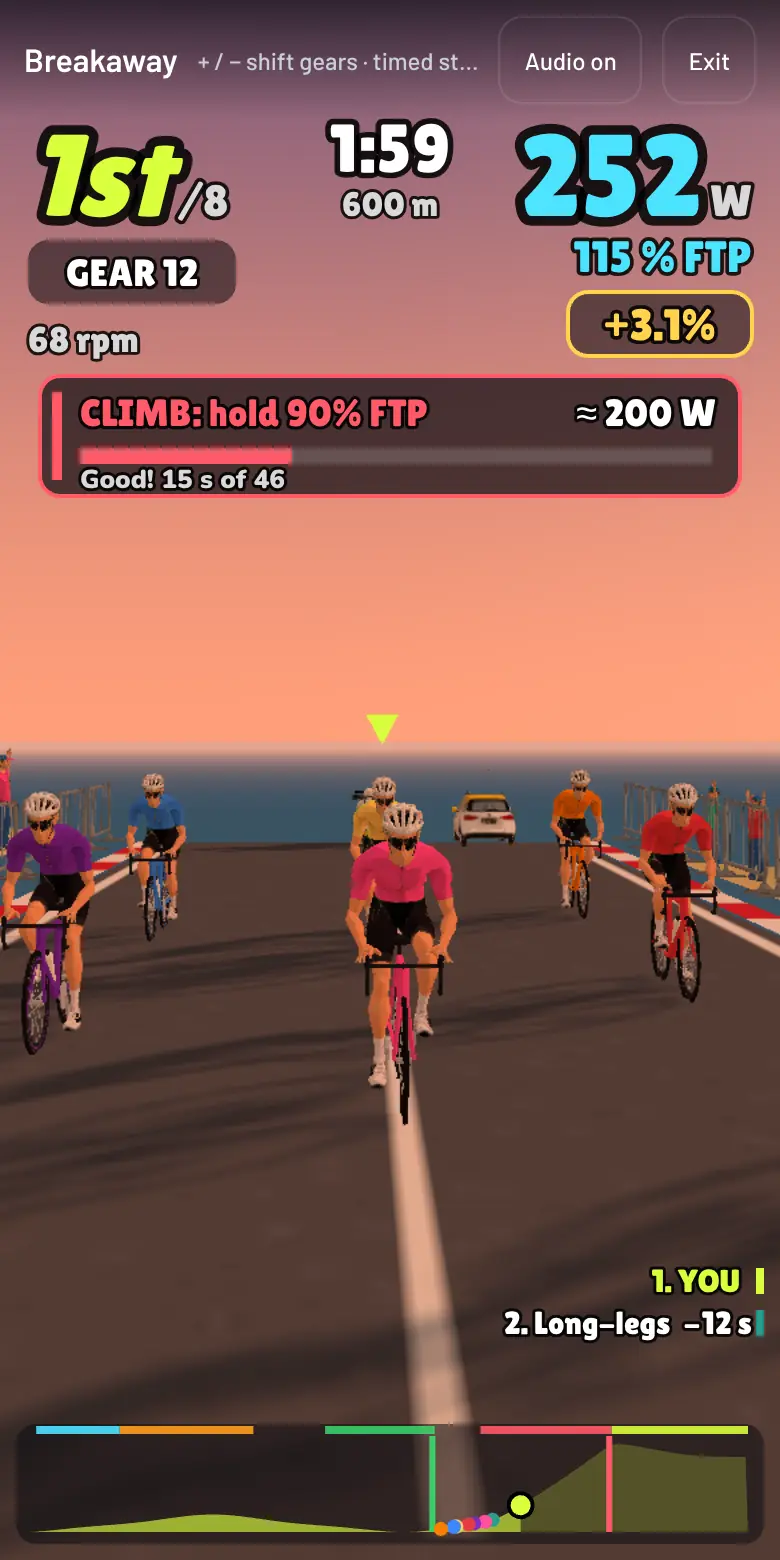
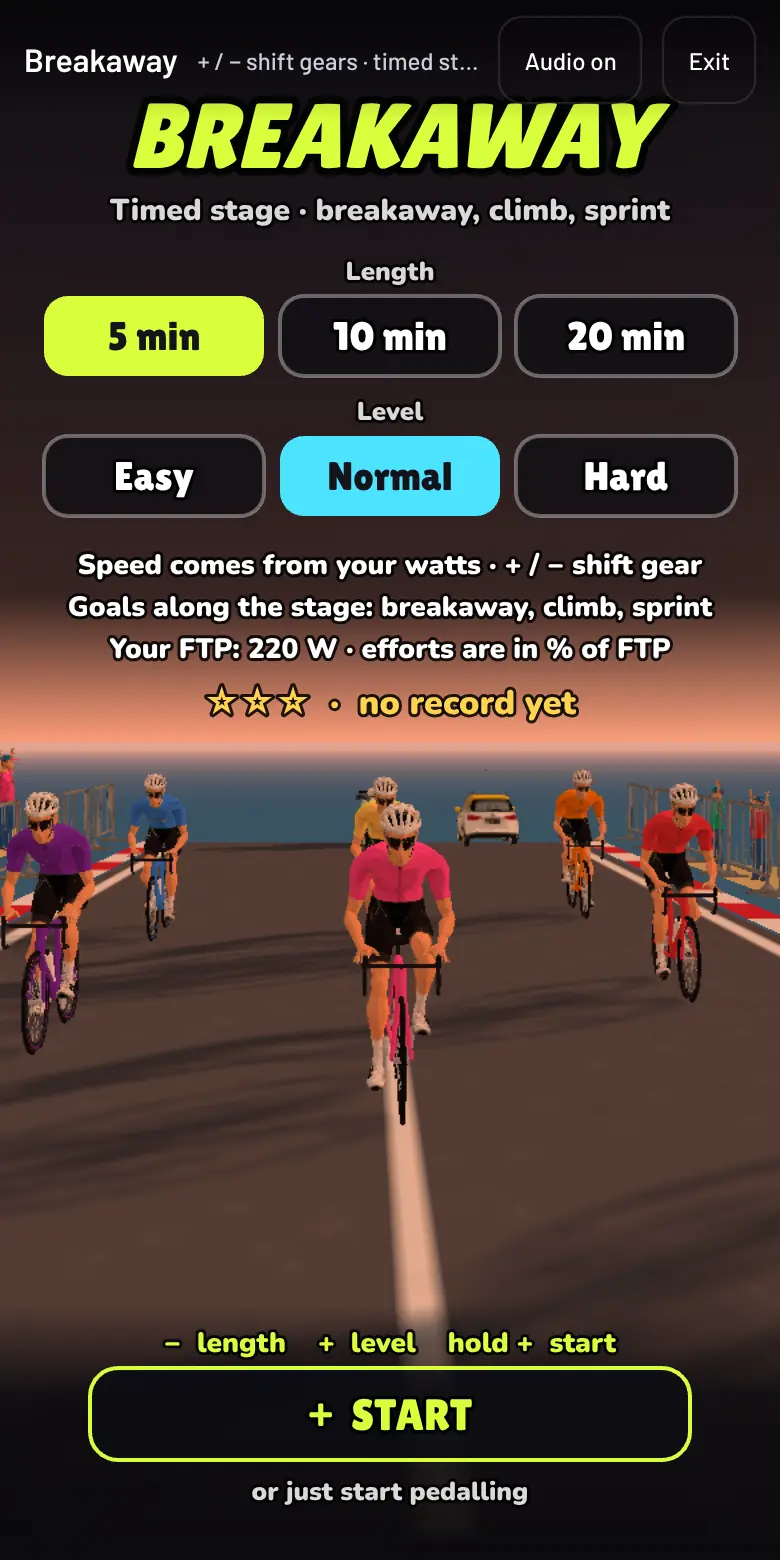
Every game session has a length you pick at the start: 5, 10 or 20 minutes. Inside it, intensity follows a curve: an easy start of about a minute, waves of effort and recovery, a harder finish, and a cooldown before the summary. We never ask for more than 90 seconds above threshold without at least 40 seconds of recovery.
All of it is expressed in percent of your FTP. Recovery is around 50 to 65%, steady riding 75 to 90%, an effort 95 to 110%, and a sprint 130% or more for a few seconds. That makes the same game fair for someone with an FTP of 120 W and for someone with 320 W. When no trainer is connected, a demo rider simulates 0.8 of FTP with a few surges, so you can look around.
Three levels, and a difficulty that adapts
Easy, normal and hard shift the percentages by about 10% either way. On top of that the game adapts a little: after two failed efforts in a row the demands drop by 5%, and after three successful ones they rise by 5%, within a limit of 15% either way. The point is to keep you in the zone where the effort is hard but not hopeless.
Something to do every few seconds
A workout that is only a number on screen is boring. The rules are strict about it:
- The first thing to do appears within eight seconds of starting.
- There is never more than five seconds without an event that asks or rewards something.
- There is always a visible goal with a bar or a counter, like "wave 3 of 8" or "400 metres to go".
- Every action gets an answer within 100 milliseconds: a sound, particles, a number that climbs.
- At the end you get one to three stars with clear criteria, a personal best, and a hint about the next star.
Playing from the bike
You should be able to play without touching the screen. Watts and cadence do most of the work. The + and − keys of a controller do one thing per game, spelled out on the menu. If you stop pedalling, the game pauses rather than punishing you, and nobody is penalised for pushing harder than asked.
Every game shares the same menu and the same results screen, so what you learn in one carries to the next.
Bring your own workout
A game does not have to invent its own session. When you start one of Spindro's workouts and open a game from it, the game follows the workout: each step becomes part of the game, and steady stretches longer than three minutes are split into waves of one to two minutes at the same target, so there are still events and a counter. In this mode the watts are set by the workout, so the level and the adaptive difficulty do not touch them. The stars are different too: one for finishing, two for staying within 7% of the target for at least 60% of the time, three for at least 85%.
The six games
Breakaway is a timed stage with a breakaway, a sprint and a climb that loads your trainer. Horde Run holds a road against waves of zombies. Pedal Strike is a runner shooter whose shields break only at the right watts. Slipstream asks you to bridge to attacking riders and tow them. Updraft is a plane whose altitude is your power. Feed Zone bounces a bottle off the soigneurs, with cadence setting its speed.
How a game is checked
Our rules say a game is not finished because it looks good. It has to be checked with a bot at four power levels, 0.6, 0.8, 1.0 and 1.2 times FTP, over a five-minute session at normal level, recording the stars earned, the time to the first event, the longest gap with no event and the events per minute. The expected result is one star at 0.6 times FTP and three at 1.2 times. The rules also ask for frame strips of real play, looked at by a person, to catch visual defects: objects popping in near the camera, models passing through each other, flicker.
All of this uses simulated trainers. We cannot tell you how a game runs on your phone, and the visuals depend on its graphics.
Build one
The games are small JavaScript modules on a shared kit that provides the menu, results, HUD, cyclist, environment and quality settings. If you have an idea for a game that works as a workout, the Build a game page shows the three steps: copy the template game, add one registry entry, add your strings. The guide takes about 15 minutes from a fresh clone to your game on screen, and a bot plays it at four power levels and tells you which rule it breaks. We would like to see yours.
Keep reading
Why we built a free indoor-cycling app
A smart trainer you already paid for, subscriptions for everything else. Why we built Spindro, what it does, and the limits we want you to know about before you try it.
Read · 4 min readHow virtual gears and ERG mode work on a budget trainer
What FTMS is in plain words, what ERG does, why the app re-sends the power target every two seconds on some trainers, how cadence is estimated from the flywheel, and what a controller adds.
Read · 5 min read